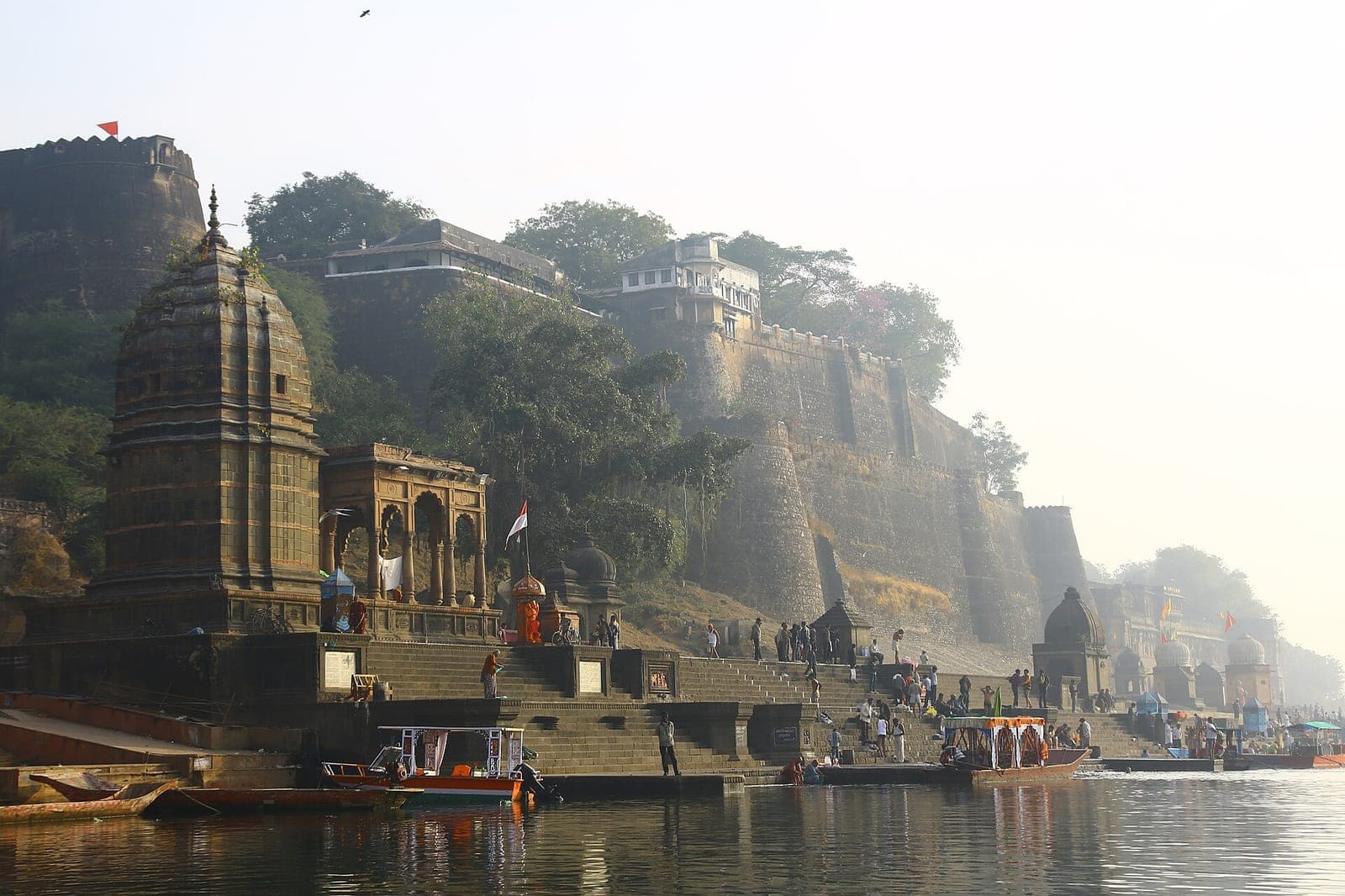
Photo: Lukas Vacovsky · CC BY-SA 3.0 · Wikimedia Commons
What is Ahilya Ghat & Fort, Maheshwar known for?
The riverfront of Maheshwar is a single sweep of stone ghats running down from the Ahilya Fort to the Narmada, with temples set along the steps. It is the heart of the town and the reason most people come: Rani Ahilyabai Holkar ruled from this fort in the eighteenth century, and her daily worship at the river is still remembered in the evening aarti held on the ghat.
Why is Ahilya Ghat & Fort, Maheshwar significant?
Ahilyabai Holkar, who ruled the Holkar state from 1767 until her death in 1795, is remembered across India for rebuilding temples, ghats and dharamshalas at the great tirthas. Maheshwar is where she lived, and the fort holds her palace and the shrine where she worshipped. Within the fort precinct the Ahilyeshwar temple stands close to the water, and the ghats below carry small shrines and memorial chhatris of the Holkar family.
Which rituals and festivals are held at Ahilya Ghat & Fort, Maheshwar?
Bathing in the Narmada at the ghats, and the evening Narmada aarti with lamps set on the water, are the central observances. Deepdaan — floating lit lamps on the river — is commonly offered at dusk.
Mahashivratri and Narmada Jayanti are the principal occasions, and Kartik Purnima brings pilgrims to the ghats. Narmada parikrama walkers pass through Maheshwar on the north bank.
How do you reach Ahilya Ghat & Fort, Maheshwar?
Maheshwar is about 90 kilometres from Indore, roughly two hours by road, and about 65 kilometres from Omkareshwar. The nearest railway stations are Barwaha and Indore; Indore has the nearest airport. The ghats are walked from the fort; boats cross to the far bank and to the small temple in the river.
Most visitors combine Maheshwar with Omkareshwar and Mandu, or with Ujjain via Indore.